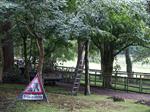
 Learn more about the culture and care of trees, tree establishment and maintenance
- Learn to identify lots of different trees; and other plants
- Learn techniques for planting, maintaining and managing trees
- Work in arboriculture
To work in the challenging and stimulating arboriculture industry you need fundamental knowledge and understanding of trees, their amenity value and their indisputable value to the environment. Such knowledge includes the maintenance and management of trees; tree assessment for health, monetary or environmental value, fundamentals of planting, transplanting, pruning, site planning, identification and treatment of pests diseases, nutritional and other disorders, tree surgery, aftercare and advice and tree removal.
Trees are the longest living organisms on Earth, they benefit the community and improve our quality of life in almost immeasurable ways. They create the oxygen we breathe, reduce air and water pollution and uptake water to help reduce storm water run-off. They also provide shade, beauty, sound barriers, windbreaks and reduce summer urban heat.
If a tree is growing in a favourable environment and its genetic make-up also favours that environment it will be healthy and grow to optimum size and shape. A knowledgeable arborist understands that this is not always the case and sometimes, through environmental or other factors, trees will need help. They will also know that working with trees is about more than felling them; once a tree is removed it cannot be put back! Arborists are there to encourage and maintain healthy, growing trees where at all possible; their work therefore has an important role in the community.
Opportunities in this growing industry include employment in private specialist contracting businesses, self-employment, local and state government positions. Activities include the maintenance and care of trees and large shrubs in private gardens, public parks, reserves, bushland reserves, recreational areas, industrial complexes, housing estates and institutions.
AIM
This course develops the knowledge and skills needed to work in arboriculture, and provides essential background training in plant identification, selection and care.
 WORKING IN ARBORICULTURE
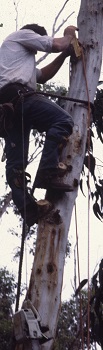
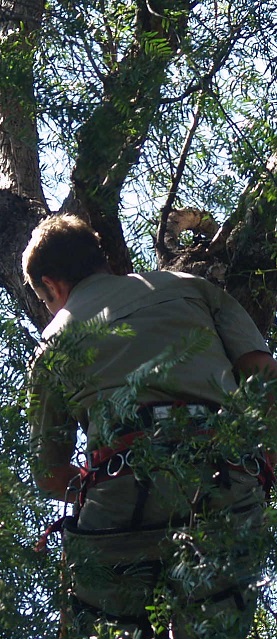
Arborists are horticultural specialists who look after trees. The work may include establishing new trees or caring for established ones. Arborists may be required to remove sick or damaged branches or whole trees, control the size and shape of trees, repair of damaged or diseased wood (e.g. bracing, propping, cabling branches to prevent them breaking), accessing parts of trees by climbing or with a travel tower, planting new trees, transplanting large trees, controlling and removing unwanted roots, controlling tree pests or diseases, or developing tree management plans.
Trees in urban areas can often become a problem. Branches can fall onto power lines, buildings or other structures. Roots can damage pavements, fences, and building foundations, or block drains.
A tree lopper is someone who removes trees, but might not understand so much about how to grow or repair them.
A tree surgeon will understand more about how to grow trees and care for their health but, in addition, still have all the same skills of a tree lopper.
Some people in this field may specialise. For example, stump removalists may provide a service to dispose of large stumps after the tree is removed. Stump grinding machines may be used for this. In some instances a stump may need to be dug out or burned. Removing a stump can result in soil subsidence, so understanding all of the implications of dealing with “leftover” roots can be a significant area of study.
Where Do Arborists Work?
Arborists may work with an arboriculture business, tree removalist, tree surgeon; being self employed working for public authorities. Some work in forestry and others in private enterprise. Many will start their careers climbing trees but often with age this type of work can become increasingly challenging. Later in their careers, some move on to being a consultant, or manager, or conduct tree inspections and write tree reports for councils. Others may leave arboriculture and find work in other areas of horticulture.
Opportunities This Course Could Provide
Arboriculture offers many different roles, dependent upon level of study and industry experience. After completing this course you may find employment in the following areas:
Non-climbing arboriculture assistants are employed to work ropes, lower branches to the ground and clear away branches. They may also operate a chipping machine. This type of work is less skilled than climbing, does not pay as much, and may be an easier job to get when starting out in this industry.
A skilled climber is always in demand, and can earn very good money however one should always consider whether this is a job you would plan to do for decades, or for a lesser period - as a stepping stone towards something else.
Some arborists work primarily with travel towers, hence don't need to have climbing skills.
Arboriculture managers are often people who have started out with a course such as this one; followed by some years of hands on experience in the field, and eventually moving on to a non climbing position as a supervisor or manager of either their own business or a department within a public enterprise or larger company.
WHAT NEXT?
Register to Study - Go to “It’s Easy to Enrol” box at the top of the page and you can enrol now.
or
Get Advice – Email us at info@acsedu.co.uk OR
Use our FREE COUNSELLING SERVICE to contact a tutor
CLICK TO CONTACT US