COURSE STRUCTURE AND CONTENT
 This is an extensive 150 hour course, studied by distance learning. You can start the course at any time - study at a pace that suits you, and with full tutor support for the duration of your studies.
The course comprises 10 lessons, covering core areas:
- The Plant Kingdom
- Plant Nutrition, The Root Environment
- Pests, Diseases and Weeds
- Sexual and Asexual Propagation
Lesson details are listed below.
Lesson 1. Classification of Plants and the Plant Naming System
- Botanical and Horticultural
- Nomenclature: common names, scientific names
- The Binomial System
- Botanical Classification levels
- Horticultural Groups
- Plant Families and their distinguishing characteristics
- Species, Hybrids, Varieties, Cultivars
- Review of significant Dicotyledon and Monocotyledon families
- Plant Life cycles
- Stages in Plant Development
- Plant Collection Reviews
Lesson 2. The Internal Structure of Higher Plants
- Plant Cell Structure
- Cell Components
- Cell Division; mitosis and meiosis
- Types of Plant Cells; Parenchyma, Collechyma,Sclerenchyma, Xylem, Phloem, Epidermal
- Internal Structure of Dicotyledon Stems: Epidermis, endodermis, cortex, vascular bundles, etc.
- Structure of Monocotyledon Stems
- External Differences between Monocotyledons and Dicotyledons
- Anatomical features of leaves and stems in cross section
- Plant Tissues
- Primary and Secondary Growth
- Terminology
- Botanical Keys and their use
Lesson 3. The External Structure of Higher Plants, Roots, Leaves, Stems and Buds
- Stems; the framework, functions of the stem
- Stem modifications
- Leaves
- Functions of leaves
- Respiration, transpiration and photosynthesis
- Leaf shapes
- Compound leaves
- Leaf modifications
- Buds: adventitious, apical, flower, vegetative
- Root Structure
- Types of Root Systems
- Root Modifications
- Morphological Changes due to Maturation
Lesson 4. Identification and Function of the Reproductive Parts of the Plant
- Parts of a flower: Sepals, Petals Stamens, Carpel
- The Inflorescence
- Flower Structure
- Types of Fruits
- Fruit and Seed Terminology
- Modification of Fruits - dry fruits, succulent fruits, composite fruits, false fruits
- Key to Main Fruit Types
Lesson 5. Pollination and Fertilisation in Higher Plants
- Pollination Processes
- Self Pollination, Cross pollination
- Pollination Mechanisms
- Compatibility
- Fertilisation, Embryo and Seed Formation
- Post Fertilisation
- F1 Hybrids
- Genotype versus Phenotype
- Male Sterility
- Parthenocarpy
- Hybrid Seed Production
- Terminology
- Seed and Fruit Development
- Seed Structure
- Seed Germination
- Fruit Set, Growth and Development
Lesson 6. The Fundamental Physiological Processes in Plants, Plant Growth and Developmental Relationships
- Importance of Photosynthesis
- The Light Reactions
- The Dark Reactions
- Chloroplasts in Photosynthesis
- C3, C4 and CAM Plants
- Rate of Photosynthesis
- Chemistry of Respiration
- Rate of Respiration
- Stages of Respiration
- Aerobic versus Anaerobic Respiration
- Transpiration and Translocation of Water
- Osmosis
- Diffusion
- Mechanisms of Nutrient Uptake
- How Water, ions and metabolites move through a plant
- Tropisms; Phototropism, Geotropism, Thigmotropism, etc.
- Chemical Growth Modification; Auxins, Gibberellins, AA, Ethylene, Cytokinin, etc.
- Effects of Chemical hormones
- Light factors in plant growth
- Artificial Light
Lesson 7. Soils and the Root Environment
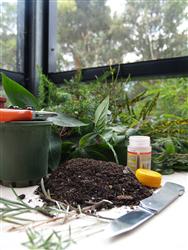 Soil Profile
- Importance of Soil
- Soil Composition
- Texture
- Structure and soil types
- Soil Horizons (A, B, C and R)
- Naming the Soil
- Improving Soil Structure
- Soil Sampling
- Improving Fertility
- Organic Matter
- Benefits of adding Organic Matter
- Soil Water and it's Value to Plants
- Water Loss from Soils
- Improving Water Retention
- Hygroscopic Water, Gravitational Water, Field Capacity and other terminology
- Saturation
- Rate of Watering
- Plant Health and Drainage
- Symptoms of Poor Drainage
- Improving surface and sub-surface Drainage
- Tensiometer
- Soil pH
- Nutrient Availability and pH
- Calcifuges and Calcicoles
- Adding Lime
- Adding Acidic Materials to Lower pH
- Conservation Issues: Peat
- Terminology
Lesson 8. Plant Nutrition
- Soil Life: Earthworms, Mycorrhyzae, Nitrogen Fixing
- Nitrogen Cycle; Ammonification,Nitrification, Detritrification, Nitrogen Loss
- Forms of Nitrogen
- The Nitrogen Cycle
- The Carbon Cycle
- The Nutrient Elements
- The Major Elements
- The Minor Elements (Trace Elements)
- Total Salts
- Diagnosis of Nutrient Problems
- Fertilisers
- Types of Fertilisers
- Applying Fertilisers
- Natural Fertilisers
- Manures, Rock Dusts, Seaweed
- Composting Methods: sheet composting, Indore method, 14 day method, compost bins, trench composting, etc.
- Green Manures
- Mulch and Mulching.
- Cultivation Techniques
- Cultivation Tools and Equipment
- Improving Water Infiltration into Soil
- Non Dig Growing Method
- Soil Problems
- Soil Rehabilitation
- Properties of Growing Media
- Potting Media: Components and Mixes
- Choosing Growing Media
- Air Filled Porosity
- Hydroponics defined.
Lesson 9. Plant Health Problems
- Factors Affecting Plant Health and Growth
- Types of Problems
- Conducting an Inspection
- Determining and Recommending Treatments
- Responding to Difficult to Diagnose Problems
- Plant Pests -major groups
- Pest Treatments - Sanitation, Physical control methods, Resistant varieties, Biological controls, Chemical controls, Soil drenches
- Insect Biology; structure, life cycles, etc.
- Review of Major Pests and their Treatments
- Review of Major Diseases and their Treatments
- Review of Environmental Problems and their Control
- Types of Weeds
- Identifying Weeds
- Weed Control Methods: Suffocation, Burning, Cultivation, Grazing, Mowing, Solarisation, Chemicals, etc.
Lesson 10. Plant Propagation Principles and Practice
- Sexual Propagation
- When to Sow Seed
- Why Some Seeds Don't Germinate
- Dormancy Factors in Seed - Hard Seed Coat, Chemical Inhibitors, Undeveloped Embryos etc.
- Difficult to Germinate Seeds
- Treatments to Break Seed Dormancy
- Seed Sources
- Seed Saving; Seed Storage
- Sowing Seed Indoors
- Seed Sowing: Germination, Temperature Control Hygiene
- Seed Propagating Media
- Sowing Seed Outside
- Handling and Caring for Seedlings
- Potting Up
- Propagation After Care
- Propagation from Cuttings
- Succeeding with Cuttings
- Types of Cuttings
- Softwood, Semi-Hardwood and Hardwood Cuttings
- Variations on Cuttings: Nodal, Heel, Tip, etc.
- Leaf Cuttings, Leaf Bud Cuttings, Root Cuttings, Bulb Cuttings, etc.
- Stock Plants for Cuttings
- Layering
- Propagation from Specialised Stems and Roots; Offsets, Division, etc.
- Propagating Tools: Secateurs, How to Cut, Knives
- Grafting
- Propagating Plants in a Greenhouse
- Cold Frames
- Heated Propagators
Each lesson includes set tasks, and is completed with an assignment which the student submits to their course tutor. The tutor will mark the assignment and return this to the student with comments and suggestions for further reading.
Where Does Good Horticulture Begin?
Anyone can grow plants. If you plant enough different plants in a garden, and wait long enough for them to grow, something will almost certainly grow. This is really more "luck" than good horticulture though.
Good horticulture involves knowing what you are doing. When you actually know what you are doing, you don't waste money and time buying plants you might get to grow, just so you can stumble across one that does grow.
Growing plants usually starts with growing them in a pot; and then once they are big enough, moving them into the ground (or a bigger pot).
Success with growing anything in a pot, always depends upon having a good potting mix for it to grow in.
How to Evaluate a Potting Mix
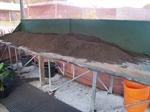
When you look at a potting mix, you will see that it contains at least two materials, and sometimes more:
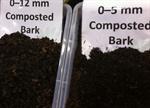
Bark – aged pine bark is a very common ingredient of potting mixes. Bark mixes are likely to drain well – perhaps too well for many plants. Mixes with lots of coarse bark ships are usually cheaper than other mixes. Finer bark chunks are preferable for most plants because they hold water better.
Sawdust – coarse, aged sawdust is used for aeration and water retention. It is an inexpensive material, and is often used in cheaper mixes.
Sand – coarse particles are often added to mixes to improve aeration and drainage. It adds stability and weight to the mix. A very sandy mix is likely to drain well and is best used for plants that prefer dry soil (e.g. cacti).
 Vermiculite – a small, soft flaky mineral that is used to improve water retention. Often used in more expensive mixes.
Perlite – sterile, porous white material used for water retention. Coarse perlite has better aeration than that with finer particles. Often used in more expensive mixes.
Peat – when it’s moist it has a dark-coloured, spongy appearance. Peat is used to retain water in the mix but if it dries out the mix is difficult to re-wet. Mixes that contain peat are more expensive.
Soil – not commonly used in potting mixes but sometimes used by nurseries that bag their own mixes. A highly variable ingredient that should only be used in small quantities in the mix.
Other materials – mushroom compost, peanut shells, blend manures and other composted plant materials are sometimes included.
Fertiliser pellets – these appear as small round balls dispersed through the mix. These will release nutrients slowly to the plant roots – usually for up to 3-6 months.
Water-retaining crystals - are very often added to potting mixes which is ideal for those of us who don’t always remember or who are too busy to water the plants. These are small transparent pellets.
Different mixes are needed for different jobs
Indoor plants – humidity is a requirement of indoor plants. Most indoor plant mixes will be high in materials that will retain moisture and promote humidity around the plants.
Baskets – these are prone to drying out so good basket mixes contain peat or other water-retentive material; also may contain water crystals
Outdoor pots, tubs planters – generally speaking, a multi-purpose potting mix will suffice for most plants. Potting mixes are high in nutrients to compensate for the fact that the plants’ roots are contained in a pot.
Acid-lovers – Acid-loving plants such as Camellias, Heathers, Azaleas and Rhododendrons are best planted in an ericaceous (acidic) potting mix. Whilst they will most likely survive in a multi-purpose mix they will grow more strongly and flower better in acid soil. If you cannot acquire an acid mix you can make your mix more acid by adding a solution such as ‘Miracid’. You can check the pH (level of acidity/alkalinity) of your potting mix with a simple soil testing kit available from your local nursery or garden centre.
Special mixes – There are a number of special mixes available for specific plant species such as Cacti and Orchids.
Checklist
 Take a checklist with you to the nursery. It could include the following points:
- What plants do you need it for? Will one mix be suitable for all your plants or will you need different mixes for different plants?
- What type of pots will you be using – plastic, terracotta, hanging basket?
- Do you want a mix that contains fertiliser and water-retaining crystals?
- Do they meet Potting Media Standards in your country (Only some countries have established standards?
- How much are you prepared to spend? Top quality mixes cost more.
If you cannot find exactly what you require, you can always mix the available potting mixes or add ingredients to make your own special purpose mix.
What’s so special about potting mixes?
Good quality potting mixes are essential for growing plants in containers. They are designed to retain moisture but drain freely. They are clean and free of diseases and weeds. They are are relatively lightweight but have sufficient ballast to support the roots and aid good plant growth. Some mixes also contain fertiliser and water crystals to help establish your pot plants.
Knowing about potting soils is only a starting point -and there's a lot more to learn to properly understand just potting soils. This course is a really good place to develop that sort of in depth understanding though.
Studying a Horticulture Course with ACS
- Our Horticulture courses have been developed by highly knowledgeable academics and experienced professionals, so you know you can expect a high quality of teaching and support.
- Studying an ACS Horticulture course by distance learning doesn't just mean learning from notes - we include practical exercises and evaluations for students. This means they can strengthen and test their learning through practical applications.
- Our courses are highly flexible - not only can you start at any time, but because the courses are self-paced, you choose when and where to study. In addition to this you also have the options to choose a study method to suit you - either online or by eLearning (USB Memory Stick).
- All your assignments and course work are assessed by your tutor, who will provide you with specific, personalised feedback.
- If you have any questions or need help with any of your studies, your tutor is on hand to provide guidance and support to you.
What are the Benefits of Studying this Course?
Graduates can be assured that they will stand in good stead for employment opportunities in a range of horticulture areas including:
- Propagation and Nursery
- Garden Retail
- Garden Maintenance
- Garden Establishment
- Parks and Gardens
What do our Students Say?
"Thanks for the videos, they are great! I got a lot of information from them. The Turf Management video is practical and easy to understand. Plant Propagation is a video every student should watch because out here in the real world no-one would give out such information. The Rose Growing Tape was very beneficial to me as I have about 60 odd roses. I thought I knew a little about them but this tape is a real eye-opener."
Kelvin
Do you want to Know More?
Our courses are designed to provide you with skills and knowledge that you can apply in the real-world. If you have any questions about studying with ACS, or need help in choosing a course to suit your aims, why not get in touch with our specialist Horticulture tutors today. They will be pleased to hear from you, and will be happy to discuss the study options available to suit you.
If you are ready to enrol it's easy to do and you can enrol now. Simply go to the enrolment box at the top right-hand side of this page - just choose your payment plan and study method (we offer a 5% discount for online study).