Learn the Ancient Art of Bonsai by Distance Learning
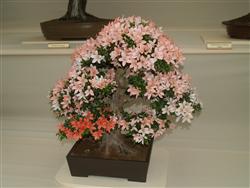 Bonsai involves growing plants in a confined situation. In contrast to the beliefs of some, growing bonsai is not an act of cruelty - although it involves confining root growth and regularly pruning the roots and top of the plant, it can be kept in a miniature form for hundreds of years (in some cases) and can vastly outlive its relatives which are growing in the wild or in gardens. Like other trees and shrubs, the bonsai is still able to produce flowers and fruit if it is given suitable care and attention.
The bonsai should look like a miniature tree, with not only the trunk and branches scaled down, but also the leaves. As such, it is preferable for bonsai to utilise smaller leafed plants.
Nurture your creativity
- Eight lessons cover the selection of plants suited to bonsai.
- Understand the history and classic shapes which form the basis of the art.
- Develop your techniques for planting, training, pruning, watering and feeding, and ways of using bonsai both indoors and outdoors.
- You will create several bonsai of your own during the course and receive constructive criticism from your tutor as they help you develop your own personal bonsai style and techniques.
Course Structure and Lesson Structure
There are 8 lessons in this course:
Lesson 1. Introduction
- Plant Taxonomy Botanical/Horticultural Nomenclature, The Binomial System, Botanical Classification, Plant Families and Species, Hybrids, Varieties and Cultivars.
- Pronunciation of Plant Names.
- Groups of Plants.
- Resources - reference books, organisations, magazines and journals, nurseries, bonsai shops, seed suppliers and the internet.
Lesson 2. Propagation
- Introduction.
- Methods of Propagating Plants sexual propagation, asexual propagation.
- Seed Propagation collecting seed, storing seed and sowing seed.
- Cutting Propagation stem cuttings, hardwood cuttings, semi-hardwood cuttings, leaf cuttings, leaf bud cuttings, root cuttings, factors affecting rooting of cuttings, striking cuttings, after care.
- Propagating Mixes and potting mixes.
- Other Propagation Methods layering, air layering and grafting.
Lesson 3. Plants for Bonsai
- Introduction.
- History of Bonsai.
- Types of plants suited for use as Bonsai sourcing Bonsai material.
- Some plant choices.
Lesson 4. Bonsai Styles and Techniques
- Classification of styles of Bonsai e.g. formal upright, informal upright, slanting or leaning, semi cascade, cascade.
- Other styles of classification e.g. sakei.
- Japanese classification.
- Bonsai Techniques.
- Bonsai Containers preparing the container.
- Wire wiring a bonsai.
- Pruning.
- Tools needed for Bonsai work pruning tools, potting tools and wiring tools.
Lesson 5. Creating Bonsai
- Principles of Design roots, trunk and branches.
- Evaluating the Bonsai and assessing additional features.
- Pruning and shaping the bonsai plant prune and grow techniques.
- Wiring wiring techniques and grooming.
- Branch Patterns in Bonsai jins, shari and driftwood.
- Root Evaluation in the Initial Stages of Bonsai potting the Bonsai, rock planting, clasped to rock design and root over rock.
Lesson 6. Bonsai Culture and Maintenance
- Soils Soil composition, colloids, structure, texture, chemical properties, improving soils, improving texture, improving structure, improving fertility.
- Soil for potted bonsai principle components.
- Particle characteristics particle size, sorting, particle shape, particle surface texture.
- Growing Medium Mixture functions of a growing medium, properties of a growing medium, drainage, water retention and colour and appearance.
- The Nutrient Elements macronutrients and micronutrients.
- Common Pest Problems on Bonsai e.g. aphids, borers, caterpillars, scale and thrips.
- Common Fungal Diseases of Plants e.g. Anthracnose, Powdery Mildew and Rust.
- Watering and Fertilising Bonsai symptoms of water deficiency, symptoms of excess water and fertilising.
- Repotting and Root Pruning the Bonsai.
- Maintenance Pruning for Bonsai removing dead/diseased wood, controlling the type of growth, controlling shape and size, rejuvenating, leaf cutting, basic rules of pruning, points to consider when pruning.
- Placing the Bonsai.
Lesson 7. Landscaping Principles for Bonsai
- Principles of Landscape Design Unity, Balance, Proportion, Harmony, Contrast and Rhythm.
- Qualities of Landscape Components line, form, mass, space, texture, colour and tone.
- Creating Landscape Effects.
- Landscape Applications for Using Bonsai group plantings, ssaikei, bonseki, bonkei, miniature gardens, rock gardens, water gardens.
- Bonsai in Tubs and Landscape Features.
Lesson 8. Special Assignment
- Research a particular aspect of bonsai of interest.
Each lesson culminates in an assignment which is submitted to the school, marked by the school's tutors and returned to you with any relevant suggestions, comments, and if necessary, extra reading.
Course Aims
- Demonstrate knowledge of the plant kingdom, an understanding of the taxonomic hierarchy, and an appreciation of the types of plants suitable for bonsai.
- Understand methods of propagation used in bonsai.
- Learn the species of plants most suited to bonsai.
- Learn a range of bonsai styles and techniques used to achieve them.
- Understand the process of creating bonsai.
- Understand the basics of successful bonsai culture.
- Understand landscape design principles to better create bonsai landscapes.
- Carry out research into a particular aspect of bonsai of interest to the student.
What You Will Do
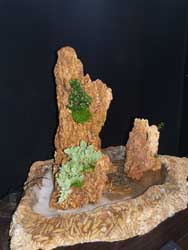 Develop plant review sheets for different plants suitable for bonsai.
 - Make up a list of resources/contacts useful to a bonsai grower.
- Research what constitutes a good propagating mix.
- Visit a nursery and observe the nursery stock present to assess suitability for bonsai production.
- Propagate different species of plant that have the potential to be used as Bonsai.
- Select different plants and determine the style of bonsai each plant lends itself to.
- Make a list of the most commonly grown varieties of plants you consider as being used for bonsai today.
- Visit a bonsai house, bonsai farm, bonsai nursery or other facility where bonsai are available for viewing and classify the style of different bonsai plants.
- Evaluate, prune, wire, shape and pot different plants as bonsai
- Obtain soil from two different types of soils; test the soils for drainage, and name the soils.
- Obtain (or make up) a potting mix which you consider appropriate for growing bonsai in.
- Conduct tests to name the potting mix you have obtained. Test the drainage of the potting mix.
- Visit a nursery or garden growing bonsai plants to assess the plants for pests, diseases and environmental anomalies.
- Design a miniature garden pot incorporating a bonsai plant
- Using your knowledge of landscaping principles, decide on the best outdoor locations three different bonsai, and the optimum indoor locations for short term display. Take photographs or sketch the locations in which you would place the bonsai. Submit these photographs with your assignment.
- Obtain plants of different varieties and using what you have learned in the course, turn your chosen plants into bonsai and either photograph or draw what you have created; then report on this work.
WHAT PLANTS CAN BE USED?
Bonsai techniques can be used with a very wide range of trees and shrubs; from all parts of the world.
Generally though; slower growing, long lived plants that have small leaves tend to make better bonsai. The problem with fast growing plants is that they often need more frequent attention to control their size and shape. Shorter lived plants are often not as appropriate because bonsai can take many years to properly train into an ideal shape.
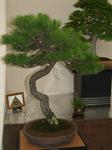 A large range of conifers are often good options because of their longevity, hardiness and small leaves. Consider pines (ie. Pinus species), for example.
In their natural environment, pines have a variety of forms from semi-prostrate shrubs to trees as high as 75 metres. They have needle-like leaves bound in groups of two, three, or five. They are very popular for bonsai.
The ‘Mountain Pine’, Pinus mugo, is a shrubby tree with a gnarled appearance though it can also be found growing as a tree in more favourable conditions. It has pairs of light green needles and brown cones. There are also a number of dwarf clones which have a naturally prostrate habit and make good smaller sized bonsai.
‘Japanese White Pine’, P. parviflora, has attractive purple bark. a low crown, wide spreading branches, and twisted blue tinged needles in groups of five. The cones can be quite large in proportion to the bonsai and so are usually removed. This also prevents too much of the bonsai's energy from going into cone formation at the expense of growth.
A number of dwarf cultivars also exist, P. parvifolia 'Miyajima' being one such example which makes good rock plantings.
The ‘Scots Pine’, P. sylvestris, is the most widely distributed pine. Young trees have a cone shaped crown but this becomes more open in mature specimens. Usually, the dwarf forms make better bonsai due to the conical growth habit of younger trees. They produce pairs of short, twisted greyish green needles. An example is P. sylvestris 'Beuvronensis', a low growing, spreading variety that has short bluish grey needles.
The ‘Japanese Black Pine’, P. thunbergii, is a tough tree that survives in harsh environments in the wild. As such, its rootstock is sometimes used to graft other pine scions onto, particularly P. parvifolia. It has a gnarled appearance like P. mugo.
Pines can be grown in all sizes of bonsai and all styles except broom. They prefer a sunny aspect. Frost and cooling winds should be avoided. They can be fertilised monthly during the growing season and re-potted every two to five years into a free draining media. New shoots can be nipped out during the growing season and overcrowded shoots and needles during the autumn. Most can be propagated from stratified seed but cultivars and dwarf varieties are better grafted.
Where to From Here?
Use this course to gain knowledge to:
- Set up a bonsai nursery.
- Produce bonsai for small scale production.
- Extend your hobby.
WHAT NEXT?
You can register to study today - all our courses are available to start at any time.
You study at your own pace, with the support of our highly knowledgeable tutors.
Thinking of studying, but unsure where to start? Simply get in touch with our specialist tutors - they will be happy to answer any questions, or help you in choosing the right course to suit your own goals.