Learn about camellias and their use
Develop your understanding of soils, feeding, watering, pruning, planting methods, pest & disease control, propagation, & more. Improve your ability to identify different varieties (both common and uncommon), and how to use camellias to achieve desired landscape effects.
This is a course for amateurs and professionals; plant collectors, camellia enthusiasts, nurserymen, landscapers, gardeners and horticulturists.
COURSE STRUCTURE
There are 8 lessons as follows:
1. Introduction
2. Culture
3. Propagation
4. Using Camellias
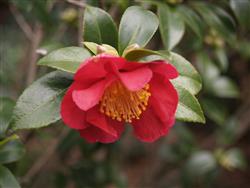
5. The most Commonly Grown Varieties
6. Other important Groups
7. The Lesser Grown Varieties
8. Special Assignment - On one selected plant or group.
Each lesson culminates in an assignment which is submitted to the school, marked by the school's tutors and returned to you with any relevant suggestions, comments, and if necessary, extra reading.
Duration: 100 hours
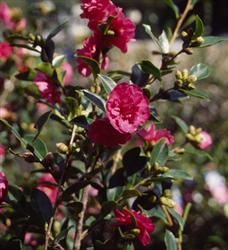
Where to Grow Camellias?
Camellias are relatively hardy, long lived plants, particularly once established. Some grow better in full sun than others. Many grow best in light to medium shade. They may not like extreme periods of heat or dry as much as some plants; but have been known to survive adverse conditions and little attention for months on end.
Camellias grow very well in shady places; but sometimes you don’t have such a place and will need to create one in order to grow camellias well. Be mindful of the fact that extreme shade might actually be a disadvantage, and the roots of large shade trees can compete with camellia roots for both water and moisture.
While excessive shade might be a problem in winter, in summer shade can provide protection from the sun and reduce water stress on plants. The obvious way to provide shade is with trees, but if you can’t wait for a tree to grow, there are alternatives. The solution here is removable shade. Use umbrellas, or an awning (that can be retracted). Some people choose to use a shade wing that can be taken down in winter and put up for the summer. A covering of a wooden or steel framework with shade cloth attached to the top or other covering such as tee tree, brush or bamboo twigs can give the protection they need from extreme sunshine and heat of summer.
Trees provide inexpensive and effective shade; but only if you use the right type of tree in the right location; and they can take many years before they are providing that shade.
Be careful to avoid trees with roots that will compete too vigorously with the camellias. Some trees grow faster than others, so they will provide shade faster. Many smaller trees grow a little slower, but will provide good shade without creating too many problems, in just about any situation.
What Cultivars are Grown?
Camellias commonly grown in the garden usually fall into one of the following species:
Camellia japonica
This is the most commonly grown type, including thousands of varieties with many different colours and flower shades. They flower from late autumn to late spring and are best in temperate climates.
Camellia sasanqua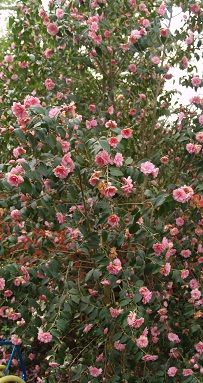
These camellias flower from mid-autumn to early winter. The flowers are smaller than japonicas, but when covered in bloom, a plant still looks spectactular. Sasanquas are more tolerant of heat and bright light than the others, and as such, are the most suited to warmer areas. They grow quite well in many sub tropical places, for example.
Camellia reticulata
These can become very large (up to 15 metres tall). They don’t have as many flowers as sasanquas, but this is made up for by the flower size (to 20cm diameter). Reticulatas are sensitive to extreme cold and in very cold areas, must be protected from frost or snow.
Camellia williamsii
While there are fewer cultivars developed from this species; some are nevertheless important. A C. williamsii hybrid called “Camellia E.G. Waterhouse”; is one of the more popular cultivars grown in Australia
Camellia sinensis
This is the commercial “tea” plant, grown in plantations to produce both black tea (made by fermenting the leaves), and green tea (made from dried, unfermented leaves). This is more often grown in the open (rather than under shade like other Camellias).
Other species that are cultivated (though less frequently) include C. cuspidata, C. saluensis and C. tsaii
WHAT NEXT?
Register to Study - Go to “It’s Easy to Enrol” box at the top of the page and you can enrol now.
or
Get Advice – Email us at info@acsedu.co.uk OR
Use our FREE COUNSELLING SERVICE to contact a tutor
CLICK TO CONTACT US