The Brain & Behaviour
Neuropsychology is a specialist area of psychology. It is relevant to people who seek a more in-depth understanding of the brain and how damage through congenital conditions, injury, disease or disorders can affect its functioning and behaviour.
Develop your understanding of brain damage.
- Learn more about the function and structure of the brain and how it affects people's psychological functioning.
- Find out about brain lateralisation, brain physiology, and neuroanatomy.
- See what happens when things go wrong: callosal syndrome, personality change, perception disorders, and motor disorders.
- Study in your own home and at your own pace. The course requires approximately 100 hours of study.
The course is useful for anyone interested in the brain and body interaction, or anyone working within the health or psychology field.
PRE-REQUISITES - A basic understanding of human biology is desirable, though not essential.
COURSE STRUCTURE
There are ten lessons in this module as follows:
Lesson 1
Foundations of Neuropsychology - What is neuropsychology? The Information Processing Approach. Studying the human mind, techniques used, brain scans, animal studies, methods of investigating the brain, psychological tests, Stroop test.
Lesson 2
Neurophysiology – Neurons, parts of a neuron, neurotransmitters, effects of neurotransmitters, neurotransmitters and their effects, endorphins, disorders associated with neurotransmitters, glia cells, Schwann cells, nerve impulse, synaptic transmission, nerve impulse, neuromuscular transmission.
Lesson 3
Neuroanatomy – the nervous system, parts of the central nervous system, the brain, the spinal cord, spinal nerves, blood brain barrier, peripheral nervous system, autonomic nervous system, sensory somatic nervous system, spinal nerves, cranial nerves, how the nervous system works (a summary), problems with brain functioning, cerebral palsy, brain tumours, injuries to the head, epilepsy, headaches, mental illness, meningitis and encephalitis.
Lesson 4
Laterality and Callosal Syndromes – Brain lateralisation, left handedness, cognitive neuropsychology, callosal syndrome, complete severance, split brain, complete severance, split brain syndrome, lobotomy, psychosurgery, Dual brain theory.
Lesson 5
Cognition, Personality and Emotion – Brain damage, emotion and moods, Phineas Gage, brain damage and emotion, frontal lobe, higher level functioning, the Limbic system, neurotransmitters, neuropsychology and emotions research.
Lesson 6
Perception Disorders – Hemispatial neglect, causes of hemispatial neglect, auditory perceptual disorder, agnosia, visual agnosia, types of visual agnosia, prosopagnosia, simultanagnosia, optic aphasia, hallucinogen persisting perception disorder.
Lesson 7
Motor Disorders – Parkinson’s Disease, motor disorders resulting from traumatic brain injury, non traumatic and/or genetic paediatric movement disorders, cerebral palsy, motor conditions, Gerstmann’s Syndrome, apraxia, motor skills disorder, motion dyspraxia, neural transplants and Parkinson’s Disease, gene therapy, how does gene therapy work, ethical issues surrounding gene therapy,
Lesson 8
Language – Broca’s area, Wernicke’s area, speech, language, speech and language disorders, apraxia, aphasia, stuttering, neurogenic stuttering, Troyer syndrome, speech disorders.
Lesson 9
Dementia – Kinds of dementia, Alzheimer’s Disease, Vascular Dementia, Multi-infarct Dementia, Parkinson’s Disease, Pick’s Disease, Dementia with Lewy Bodies, Huntingdon’s Disease, Pseudo-Dementia, spotting dementia and other conditions,
Lesson 10
Neurodevelopment - Major processes of neurodevelopment, neurogenesis, migration, differentiation, apoptosis, aborisation, synaptogenesis, Asperger Syndrome, neuroplasticity and brain damage.
Aims
- To describe the relevance of neuropsychology to managing psychological disorders.
- To explain the physiology of the nervous system.
- To describe the anatomy of the nervous system.
- To describe how conditions within the brain affect the way in which a person is physically capable or incapable of performing a variety of different tasks.
- To explain how various aspects of a person’s thought processes may vary according to that person’s neurobiology.
- To describe a variety of perceptual disorders.
- To explain a variety of motor disorders.
- To explain the neuropsychology of language.
- To differentiate between different dementias.
- To explain aspects of development in neuropsychological terms.
EXAMPLES OF WHAT YOU MAY DO IN THIS COURSE
- Learn about the development of Neuropsychology and techniques used in human neuropsychological studies;
- Describe the Neuroanatomy of -
-Brain stem
-Cerebellum and cerebral cortex
-Organisation of the cerebral cortex
-Cranial nerves , brain covering, ventricular system, arteries
-Brain malfunction
-Visual system
-Other systems;
- Determine why there is laterality;
- Discuss callosal syndrome;
- Discuss and compare theories of frontal lobe function;
- Contrast normal aspects and abnormal aspects of emotion from a neuropsychological perspective;
- Develop a diagnostic table of perceptual disorders;
- Determine how the brain perceives faces;
- Discuss language formation;
- Describe language disorders;
- Develop a table of kind of dementia;
- Learn how recovery of function is affected across age spans.
Student Comment - " The online courses are very easy to use and follow. Prompt friendly replies from tutor to any queries. Course structure flows freely. Very satisfied with course and results..."
- Diana (completed ACS Online course in Intro to Psych and Psych & Counselling)
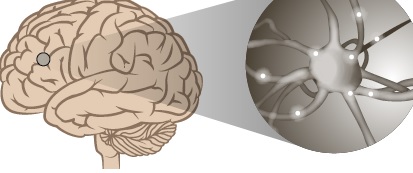
Neuropsychology studies the structure and functions of the brain
When you understand brain structure and function; you develop a completely different perspective on how and why people think and behave as they do.
Neurons, or nerve cells, are the elementary building blocks of the brain. They are the physical component underlying mental processes and different types of neurons have different functions. They transmit messages across junctions called synapses using mainly chemical, but sometimes electrical, transmitters. These transmitters can also shed light on behaviour.
How Neurons Transmit Messages
Reflex actions can be understood in terms of action potentials. If you touch something hot it triggers activity in a neuron. This then triggers activity in a second, third, fourth neuron and so forth until muscles in the hand react. Information is passed along the neurons as pulses of electricity called action potentials. Each neuron ion the sequence undergoes a series of action potentials in response to the heat message. This action is localised and occurs at the spinal cord. It is a spinal reflex.
Our reaction to the sensation of heat, or other stimuli, has two components. As well as the reflex action there is involvement of neurons in the brain which is also communicated via action potentials. The brain then makes decisions through perception, memory, emotion and decision-making processes.
Neurochemistry
Neurochemistry is the study of the effects of neurochemicals in our brains. They include neurotransmitters that influence the function of neurons, and also psychopharmaceuticals that affect how the brain functions.
Neurons
These are nerve cells. They are electrically excitable cells that transmit and process information through chemical and electrical signals. They transmit these signals through synapses (specialised connections with other cells).
We have already mentioned neurons briefly so far, but let’s look at the normal functioning of the brain in a bit more detail.
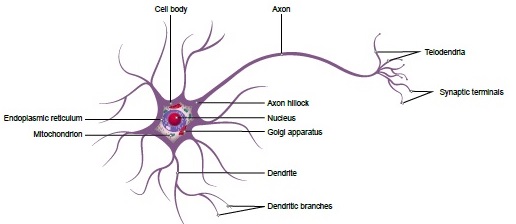
Neurons are the basic unit of the brain. They are highly specialised and are developed for sending messages. They are made up of three basic parts –
- Cell body – containing the nucleus, cytoplasm and cell organelles. The nucleus contains DNA and the material for growth, repair and metabolism. Cytoplasm is the substance that fills the cell and contains chemicals and parts for the cell to work properly, including smaller structures called cell organelles.
- Dendrites – branch off from the cell body. They are the neuron’s point of contact and enable the neuron to send and receive impulses from other neurons.
- Axons send and receive impulses from other nerve cells.
Each neuron has a cell membrane which separately the cell from the surrounding environment and controls what enters and leaves the cell. It also helps the cell to maintain the balance in its environment.
The neurons connect to form neural networks and are the core components of the nervous system. Neurons can be grouped into three types:
- Sensory neurons (receptor neurons) – these send signals to the brain and spinal cord. They respond to sound, light, touch or chemicals. Nerve endings pass impulses along dendrons on to sensory neurons and then along axons to the next neuron and so on all the way back to the central nervous system. Specialised sensory neurons are responsive to particular stimuli e.g. sound waves and are relatively insensitive to others.
- Motor neurons (effector neurons) – these receive signals from the spinal cord and brain which cause muscles to contract and affect output from glands. In other words, they instruct muscles and glands how to act in response to sensory information which has been received via the sensory neurons.
- Inter-neurons - these are neurons which connect to other neurons in the same area of the brain or spinal cord. They may receive information from several sensory neurons and pass it one to a number of motor neurons. Some inter-neurons receive information from other inter-neurons and pass it on to yet others before it is ultimately passed on to motor neurons.
Why Study This Course?
The course doesn't cover how to undertake psychological testing of neuropsychological problems, but it does provide students with a solid grounding in brain dysfunctions.
This course will mainly appeal to people working in:
Psychology
Psychotherapy
Biological sciences
Health sciences
Psychiatric nursing
Health professions
Teaching
Research
WHAT NEXT?
Register to Study - Go to “It’s Easy to Enrol” box at the top of the page and you can enrol now.
or
Get Advice – Email us at info@acsedu.co.uk OR
Use our FREE COUNSELLING SERVICE to contact a tutor
CLICK TO CONTACT US