Learn about the Human Body's Muscular System
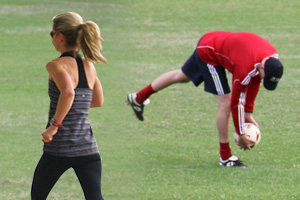
- A great subject area to complement studies in fitness, science and health science.
- Advance your biology knowledge - learn more about energy and movement.
- Learn about anatomy and function.
- Gain importance knowledge for exercise science.
COURSE STRUCTURE
There are 8 lessons in the course, as follows:
Lesson 1. How Nerves Work
- Structure of the nervous system
- Neuron function
- Anatomy of neurons
- How muscles work with nerves
- Basic body functions
Lesson 2. Nerves and Motor Skills
- Overview
- Synapses
- Neurotransmitters
- Neural circuits
- Science of motor skills
- How motor skills develop
- Physiology of the central nervous system
- Homeostatic reflex arc
- Spinal chord and spinal nerves
- Central sensiomotor programs
Lesson 3. Skeletal Muscle
- The skeleton
- How bones form
- Anatomy of bone
- Fractures and fracture healing
- Types of bones
- Bone joints
- Skeletal muscles
- Smooth muscle
- Striated voluntary muscle
- Cardiac muscle
- Relationship between muscle and skeleton
Lesson 4. Muscle Organisation
- Parts of the muscular system: tendons, deep fascia, epimysium etc.
- Types of muscle fibre
- Muscle types: striated, smooth, cardiac
- Skeletal muscle types: slow oxidative, fast glycolic, etc.
- What muscle cause what movement
Lesson 5. Muscular Movement
- How do muscles move
- How skeletal muscles produce movement
- How levers are used to produce muscular movement
- Group actions
- Terminology
- Muscle groups and movements
Lesson 6. Muscular Development
- Muscular body function
- Energy systems
- Muscular strength
- Muscular endurance
Lesson 7. Muscle Flexibility
- Introduction
- Flexibility
- Excitation contraction of muscle
- Different levels of flexibility
- Internal flexibility
- External flexibility
Lesson 8. Muscles and Posture
- Posture
- Gravity support
- Net movement
- Benefits of posture
- Good posture
- Postural mechanisms
- Slow and fast twitch muscles
- Nervous system feedback
- Posture improvement
- Ergonomics
Each lesson culminates in an assignment which is submitted to the school, marked by the school's tutors and returned to you with any relevant suggestions, comments, and if necessary, extra reading.
A Summary of Competencies Developed
On successful completion of the course you should be able to do the following:
- Explain how nerves cause reactions in the human body.
- Explain how the nervous system affects motor skill performance.
- Explain the function and structure of skeletal muscle in the human body.
- Describe the organisation of muscle tissue in the human body.
- Describe the mechanics of muscular movement.
- Explain development of muscular strength and muscular endurance.
- Selecting muscular flexibility exercises.
- Explain significance of muscles to posture and general well being.
What the Course Covers
Here are just some of the things you may be doing:
- Draw a cross section of the spinal cord, and label the anatomical parts.
- Explain what happens when an electrical stimulus is sent along the central nervous system, by illustrating and labelling the reflex arc.
- Explain nerve to nerve synapses, during a specific body movement.
- Explain activity at muscle-nerve junctions, during the specific body movement.
- Explain how proprioceptors function, during the specific body movement.
- Explain processes which occur in the nervous system, when a specific muscle moves.
- Explain the functioning of the following different sensory receptors:
- Distinguish between the functions of the following different neuroglia:
- Astrocytes
- Oligodendrocytes
- Microglia
- Ependymal cells
- Neurolemmocytes
- Satellite cells
- Explain how the function of different parts of the brain affect different specific muscular movements in the body.
- Explain how a specific voluntary skill is learnt by the body.
- Explain the dampening affect, as exerted through the cerebellum.
- Explain how the body perceives speed through the nervous system.
- Explain the operation of tendons, during a specific movement of a limb.
- Compare the function of motor with sensory fibres in nerves supplying muscles.
- Compare differences in the structural characteristics of red and white muscle fibres.
- Summarise events occurring during muscular contraction, at a microscopic level.
- Explain how muscles of the hand move when you pick up a tennis ball.
- Prepare diagrams showing the muscles in the back which provide both support and movement for the spinal column.
- Explain the significance of these muscles to health, well-being and mobility.
- Explain the principle of levers related to an observed muscular movement.
- Explain the principle of moments related to an observed muscular movement.
- Explain muscular movements which occur in the observed subjects, when using three different types of exercise machines.
- Explain three different body movements, in terms of the action of different bones, muscles and nerves; including the movement of a limb in exercise, and the bending of the back, and one hand movement.
- Distinguish between isotonic, isometric, eccentric and isokinetic contractions.
- List ways how strength can be maintained and increased.
- List ways how endurance can be maintained and increased.
- Explain three different physiological changes which accompany increased strength.
- Explain the overload principle, related to muscular development.
- Explain biological processes in force to effect strength and endurance in an athlete observed and interviewed by you.
- Compare static and dynamic flexibility, in an individual observed by you.
- Explain the structural limits to flexibility, in three different people of different ages.
- List ways of developing flexibility in a specific individual.
- Explain the relationship between flexibility and aspects of performance in a specific case study.
- Develop an exercise program to develop/maintain flexibility for a person.
- Submit photos together with comments on the posture of each person you studied. Comment on the age, sex and occupation of each of these people.
- How might posture affect general well being, including arthritis and back pain.
From our Students ...
" ...it is very informative and worthwhile. I am glad I started the course. Of the many available from different schools, this offers the best value for money. "
- Sonia, studying Human Biology
"The information given was excellent, but the assignments also made you look further to find answers yourself and I find this a much better way of learning than just being handed all the answers. It has given me a grounding knowledge in human biology which is perfect as I am applying to study Chiropractics at university next year. I couldn’t have asked for more from my tutor. She was very thorough and extremely helpful with any problems I encountered".
- Kate, Anatomy
What Next?
Register to Study - Go to “It’s Easy to Enrol” box at the top of the page and you can enrol now.
Or, Get Advice - if you have any questions about the course, please get in touch with our specialist Science tutors - they will be pleased to hear from you.