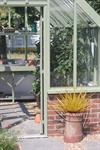
Distance Learning Course Protected Plant Production
“Successful protective plant cropping requires the practical skills and knowledge you will gain when undertaking this course. A specialized field of growing covering all types of crops and ornamentals – this course with give you broad practical plant husbandry skills.” - Gavin Cole B.Sc., Psych.Cert., Cert.Garden Design, MACA, ACS Tutor
COURSE STRUCTURE
There are seven lessons in this module as follows:
Course Aim
Successful completion of this course/module will develop your broad understanding of practices and processes involved in successful protective plant cropping.
It will develop a clear understanding of environmental control and plant growth within a protective environment, together with a practical knowledge of plant husbandry techniques.
CONTENTS
There are seven lessons in this module as follows:
1. Structures for Protected Cropping
Describe and Evaluate the type and shape of modern growing structures.
2. Environmental Control
3. Cladding Materials and their Properties
4. Irrigation and Nutrition
5. Relationship between Production techniques and Horticultural practices
6. Harvest and Post Harvest Technology
7. Risk Assessment
This is an individual module. The individual module courses are 100 hour long usually and can be taken on their own or as part of a larger program of study. Other qualifications, such as certificates, diplomas etc may require examinations to be taken as part of the overall assessment process.
For individual courses - If you want to take one of these courses only, you can elect to sit an optional exam at the end of it. If you successfully pass the exam, you will receive a Statement of Attainment. If you do not wish to take the exam, you will receive a Course Completion letter when you have passed all assignments. You can take examinations at a time and location to suit you. If you enrol, you will be sent further information on how to arrange examinations at the end of the course. If you do not wish to sit the examination, you will need to complete all assignments to receive the course completion letter. There is an assignment at the end of each lesson. So for example, if an individual module course contains ten lessons, you will need to complete ten assignments. Assignments can be sent to us via email, post or fax.
Click here for more information on exams.
LEARNING OUTCOMES
- To Describe and Evaluate the type and shape of modern growing structures
- To describe and evaluate environmental controls in protected cropping
- To explain the nature of solar radiation, transmission properties of glass and its substitutes
- Determine the water requirements of a crop; and methods of irrigation.
- Relate horticultural principles to the production and harvesting of a range of crops.
- Evaluate the factors involved in marketing protected crops
- Undertake risk assessment
WHAT WILL YOU DO IN THIS COURSE?
This course involves both practical and theoretical tasks which involve you doing a wide variety of things, including:
- Identify the main types of growing structure
- Relate use of structures to shape and type of construction
- Identify the range of environmental factors controlled within a growing structure
- Describe the use of the equipment used to measure and monitor these factors
- Name and describe a range of types of environmental controls
- Evaluate the use of IT facilities for environmental control
- Describe the meaning of “daylight” and explain the role of sunlight and diffused light
- Relate time of year to the quantity and quality of available light
- Evaluate how the shape and orientation of a structure will affect light transmission
- Assess the effectiveness of glass and cladding alternatives for light transmission
- Describe the durability and insulation properties of glass and alternative materials
- Select and describe appropriate systems of irrigation for plants grown in situ
- Select and describe appropriate systems of irrigation for container grown plants
- Specify and evaluate systems for incorporating plant nutrients into the irrigation water
- Explain the effects of environmental control on a range of plants
- Relate the essential features necessary for successful plant establishment and development to their underlying scientific principles.
- Describe the production of a range of crops
- State the optimum stage of growth for harvesting a range of crops
- Describe the harvesting systems for protected crops
- Explain how shelf life can be affected by pre and post harvesting treatment of the crop
- State the factors to be considered when marketing crops
- Evaluate alternative marketing outlets
- Relate packaging & presentation to marketing
- Assess benefits to the grower and customer, of grading a crop before marketing
- Determine elements of risk in the practical operations associated with protected plant production.
- Identify safe working practices
More Information on ACS Distance Education and our courses
Who are our tutors?
Our tutors are all highly experienced and professional, knowledgeable in their field of study. We have staff from around the world, enabling us to gain a wide variety of perspectives. We have a school in the UK and in Australia. If you would like to have a look at our tutors, then click on the “The School” in the boxes above and choose “The Staff” option.
Sample Course Notes
Our courses are all written by highly qualified tutors and writers, who also teach on the courses, so know them well. We strive to update our courses and improve them with new information, methods and knowledge on an ongoing basis. If you would like to see examples of some of our courses, then choose the “Enrolment” option above, and then click on “Sample Course Notes”.
What learning method should I choose?
We offer three learning methods – e-learning, correspondence and online. If you are not sure which is the right choose for you, then click on the “Enrolment” box above, then “Learning Methods.”
How Long will it take to complete the course?
This obviously varies from student to student. Some students will have more time for study than others. Some students may work quicker than others, so it is an individual thing. We estimate that most students will take, for example, 4 – 6 months to complete a 100 hour individual module, but we allow up to 12 months for you to complete it.
Longer courses will obviously take longer. You can find more information on the length of time required and so on the “Enrolment” box, then selecting “Terms and Conditions of Enrolment.”
What Do Our Students think of us?
If you would like to read comments from our previous students, then choose the “Enrolment” option above, then “Student Testimonials”.
I don’t think this is the right course for me.
If you’re not sure about this course, then why not look at our wide range of other courses. Click on the “Courses” box above.
You may also wish to design your own course to fit in with exactly what YOU want. To do so, click on the “Enrolment” box, then “Design your Own Course”.
If you would like more advice on a course, then you can contact us and ask a tutor about the courses. You can contact us by calling 0800 328 4723 or +44(0) 384 442752 or emailing info@acsedu.co.uk
Recognition and Accreditation
For more information on our recognition and accreditation, click on “The School”, then “Recognition”.
Who is ACS Distance Education?
If you want to know more about ACS and our history, then please click on “The School”, then “About us.”
Horticulture Tutors
Diana Cole B.A. (Hons), Higher Dip. (Garden Design), RHS Advanced Cert. Horticulture, Cert Admin.Mgt., Dip. Inst. Personnel Management
In addition to her RHS horticulture, garden design, City & Guild construction, NPTC pesticide/legislation and business/management qualifications, Diana has a variety of skills drawn from setting up Arbella Gardens, a landscape gardening business. She also has administrative, management and training delivery experience drawn from her employment in other organisations such as the NHS and other educational institutions such as schools & universities. She has augmented her training expertise having gained the Preparing to Teach in the Life Long Learning Sector qualification. She also has experience gained through working as a volunteer in a number of different roles including amenity style gardening in parks and practical conservation work. Diana is also a member of the National Society of Allotment and Leisure Gardeners Limited (NSALG).
Maggi Brown Cert.Ed.(Environment)
Maggi is regarded as an expert in Organic Growing throughout the UK, having worked for two decades as Education Officer at the world renowned Henry Doubleday Research Association (now Garden Organic). She has been active in education, environmental management and horticulture across the UK for more them three decades.
Yvonne Sharpe RHS Cert.Hort, Dip.Hort, M.Hort, Cert.Ed., Dip.Mgt.
Having over 30 years of experience in horticulture, education and management, Yvonne has travelled widely within and beyond Europe, and has worked in many areas of horticulture from garden centres to horticultural therapy. She has served on industry committees and been actively involved with amateur garden clubs for decades. Yvonne is also a member of the National Society of Allotment and Leisure Gardeners (NSALG).
Thady Barrett M.Hort (RHS)
Thady is a consultant to the horticulture industry in the UK, with particular interest in the ornamental plant sector. Previously he was a senior lecturer at Writtle College for 20 years which included being course tutor for RHS qualifications. Wide ranging practical horticultural experience but with specific interest in propagation techniques and plant production technologies. Member of the International Plant Propagators Society (IPPS) and awarded the Rose Bowl Award in 2009 in recognition of his contribution to the society.
Why Choose to study with ACS?
- Service –We put the student first; tutors and administration
can be contacted 5 days a week, 50 weeks of the year, by phone or email. - We provide better Learning – we’ve been delivering distance
education for over 3 decades, and we understand how people learn by home study.
Our methods are unique, developed through trial and error always with our focus
squarely on helping you learn. - Up to Date –We are continually revising and updating
courses. We listen to our students feedback and we always improve the course if
a change is identified that will help significantly improve your learning. - More Choice –Graduates need a set of skills that will set
them apart and give them an advantage over competition in the world after
study. We have a wide variety of study choices, and give you lots of options to
choose different paths throughout a course. Doing this has meant an ACS
graduate is always different to other ACS graduates; and that difference has
made our graduates very successful. - No Short Cuts –You can’t take short cuts in learning; and
that is why our courses are often longer than what you find elsewhere. Sure,
anyone can study a short course, quickly sit an exam (while the information is
fresh) and pass; but if you want to really understand something and retain it,
that takes time. - More than just Learning Facts –We understand that success in
the workplace or business requires you to not only learn things, but also build
networks, understand the commercial world, be able to solve problems, communicate
with people, and have an attitude that will function in your chosen industry.
Our courses are designed to develop all of these things.

Protected Plant Production Home Study Course
Develop your understanding of the practices and processes involved in successful plant cropping.
Gain a clear understanding of environmental control and plant growth in a protective environment.
Learn practical knowledge of plant husbandry techniques.
Study in your own time and at your own pace.
Learn more from our tutors – experts in the field!
“Successful protective plant cropping requires the practical skills and knowledge you will gain when undertaking this course. A specialized field of growing covering all types of crops and ornamentals – this course with give you broad practical plant husbandry skills.” - Gavin Cole B.Sc., Psych.Cert., Cert.Garden Design, MACA, ACS Tutor