Bird Behaviour Problems
Why Do Birds Develop Behaviour Problems?
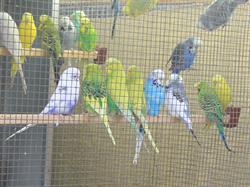 Behaviour problems in aviary birds can include biting, screeching, feather picking and other phobias. These behavioural problems usually occur when the bird’s needs are not being met. The basic needs of birds include food, water, shelter, rest and appropriate social interaction. Some factors which might contribute to behavioural problems can be:
- Cage size – The cage needs to be large enough for the bird to comfortable. As a general rule, cage sizes should be a minimum of 1-1/2 times larger than the bird’s wingspan.
- Cage location – This will depend on the nature of the bird. If it is a very gregarious bird it should be in a position where it is near family activity. If it is a timid bird, place it in a position where it is near a wall so it feels that it can hide if necessary.
- Cage height – ensure cages are not on the ground as this can make birds feel extremely vulnerable.
- Boredom – if the family members are away from the house for extended periods of time, it is important to provide a bird with toys and to rotate these toys regularly to relieve boredom.
- Sleep deprivation – birds can require up to 12 hours sleep per night. Due to artificial lighting in homes this may not always occur. The best thing to do is to move the bird to a quiet part of the house at night to help with sleep.
- Social interaction – there are various ways in which to interact with the bird to modify anti-social behaviour. These can include changing the tone of voice, being more expressive with the bird so it understands the consequences of certain behaviours. Ensure that whatever method you use that you are consistent. It is a good idea to consult a veterinary expert of bird behaviourist for the best advice on how to treat serious behavioural problems.
When Birds Become Territorial
It is usual for a bird to look for a territory during mating. This is an area defended by one or both members of a pair. There are four general types of breeding territory:
- A space sufficiently large to serve the pair and all their needs, courtship, mating, a nest site, and enough foraging ground for the parents and the offspring.
- An area where all the breeding activities take place, but not large enough to supply all the necessary food.
- A small space, usually just large enough for the nest and immediate surroundings.
- A display ground, used by males, either singly or in groups, to attract the females and allow mating to take place.
In the defence of their territory, birds seldom resort to fighting. Instead, they adopt threatening displays, vocalising and chasing. Not all territories are used for breeding. Some birds have individual spaces for night roosts, or for wintering grounds. These spaces are also defended.
Noisy Birds
All birds make some kind of sounds. These are not necessarily from the voice box; but in most cases it is vocal. Sounds can include:
- the whistling of a woodcocks wings.
- bill clattering of storks and toucans.
- drumming of woodpeckers.
Many vocalisations are characteristic of the species, and can be quite musical, particularly in Passerines (perching birds of the order Passeriformes, discussed in lesson 7).
Quiet "location" notes are used to keep a flock together when they are in flight, or to keep track of a mate. The young birds make "begging" calls that stimulate their parents to give them food.
There are also "alarm" signals to let others know of danger. Other calls may announce finding food, or may be made to bring a flock together for roosting. A few use calls for "echolocation" in dark areas such as caves (eg. like bats do).
Bird vocalisations are approximately similar to language. Different sounds have different meanings. The way a sound is made can identify a species, and sometimes even an individual. Although the sounds that a bird can make are largely determined by genetic factors, many species may actually learn sequences of notes partly or even fully. Some birds even develop local "dialects" for their songs, while others such as lyrebirds and parrots are skilled mimics. These "mimics" can copy sounds which are not normally made by birds -human voice, songs of other birds, even a creaking windmill, etc.
[26/04/2024 17:19:30]