GROW YOUR KNOWLEGE OF DECIDUOUS TREES
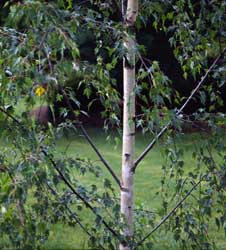
- Develop your ability identify, grow, and maintain a wide selection of deciduous trees.
- Learn about tree propagation.
- Learn about using deciduous trees in the landscape.
- Gain detailed knowledge of deciduous trees such as Acers, Birch, Ash, Oak, Prunus and more.
- Learn skills working in arboriculture, tree surgery, land rehabilitation or forestry.
LESSON CONTENT
There are eight lessons in the course as follows:
Lesson 1. Introduction
- Plant classification
- Scope and nature of Deciduous Trees
- Planting methods
- Using trees - creating a mood with trees
- Soils, nutrition, pruning
- Propagation
Lesson 2. Maple - Acer
- Scope and nature (approx. 200 species plus cultivars)
- Cultural needs
- Selected species and varieties
- Propagating maples
- Grafting, Seed, Cuttings
- What makes foliage change colour
Lesson 3. Birch - Betula
- Birch family characteristics
- Birch cultural requirements
- Species and cultivars
- Propagating Betula ... cuttings, layering
- Grafting, Budding techniques
Lesson 4. Ash - Fraxinus
- Overview of Fraxinus
- Sub genera (ornus and fraxinaster)
- Cultural requirements
- Understanding autumn colour variations
- Selected popular species and cultivars
- Less commonly grown species
- Culture of Fraxinus; pest, disease, propagation, etc
Lesson 5. Oak - Quercus
- Overview and cultural requirements
- Botany
- Cultivars
- Propagation
Lesson 6. Prunus
- Scope and nature of the genus
- Culture
- Selected species and cultivars
- Plums
- Peach and Nectarine
- Cherry
- Prunus propagation
Lesson 7. Other Deciduous Trees
- Alnus
- Cedrella
- Lagerstroemia
- Lireodendron
- Liquidambar
- Magnolia
- Malus
- Platanus
- Populus
- Pyrus
- Salix
- Sambacus
- Syringia
- Ulmus
Lesson 8. Special Project
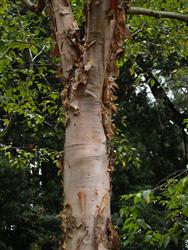 A problem based learning project with the following aims:
- Identify factors that will affect the successful culture of a specified group of deciduous trees in a specified locality.
- Determine criteria for selecting cultivars of deciduous trees.
- Select cultivars of deciduous trees appropriate for cultivation in a specified situation.
- Choose plant establishment techniques appropriate to the cultivation of selected deciduous tree cultivars in a specified locality.
- Determine a routine 12 month maintenance program for a selected collection of deciduous tree cultivars to be grown in a specified locality.
COURSE AIMS
- Review foundation knowledge in plant identification and culture as needed to properly build expertise specific to deciduous trees.
- Develop knowledge in classification, identification and culture of plants, from the genus Acer, Betula, Fraxinus, Quercus, Prunus and more.
- Review a range of other significant deciduous tree genera not covered previously in this course.
- Plan the establishment of a collection of different cultivars of deciduous trees suited to growing in a specified locality.
WHAT MAKES FOLIAGE CHANGE COLOUR IN AUTUMN?
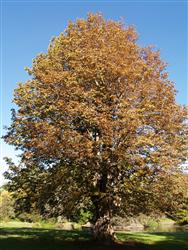 Deciduous plants lose leaves in autumn or early winter, and are fully or partially devoid of foliage over the colder months of the year. This is an adaptation that allows the plant to better survive unfavourable conditions (such as extreme cold). Prior to leaves dropping they undergo a period of senescence. Senescence is the period during which leaf cells progressively die.
Over this senescence period, tissue at the leaf base progressively dies, until finally a complete section of tissue between the leaf and the stem is dead (At this point there is nothing left to hold the leaf to the stem; so it detaches and drops to the ground).
As senescence occurs, the amount of chlorophyll in the leaf (which gives it the normal green colour) reduces. Chlorophyll is actually only one of many pigments that generally occur in leaves; but it is usually the strongest pigment, and for that reason alone, most leaves usually appear green if the plant is healthy.
Other types of pigment chemicals commonly found in leaves include:
- Anthocyanins –Reds, Blues and Purples
- Carotenoids –Yellows and Oranges
Generally Carotenoids also decompose rapidly in Autumn, but Anthrocyanins break down much more slowly.
Often Anthrocyanins can still be at close to 100% normal levels when only 40% of normal chlorophyll and carotenoids remain.
Anthrocyanins are produced through chemical processes, from excess sugars in the leaves, particularly in the presence of bright light. In view of this fact; the level of anthrocyanins will be stronger if the plant has been actively photosynthesising (producing sugars) over summer, combined with lots of bright autumn days (if weather is frequently overcast and dull in late summer and autumn; the production of anthrocyanins is decreased).
Lower temperatures in autumn reduce the movement of sugar around the leaf, so if the weather changes from warm to cool fast, the leaf sugar remains high and anthrocyanins build up; otherwise the levels of these pigments might not be so high.
High levels of anthrocyanins will generally result in more vivid autumn foliage colours.
ENROL TODAY AND BECOME A DECIDUOUS TREE EXPERT
- Gain specialist knowledge of deciduous trees.
- Study by distance learning with the guidance and support of our expert tutors.
- Study when and where you want to online.
If you have any questions about the course, or studying with ACS, please get in touch with our course advisors. They love to answer questions and discuss learner's goals.