Bromeliads
The Bromeliad Family (Bromeliaceae)
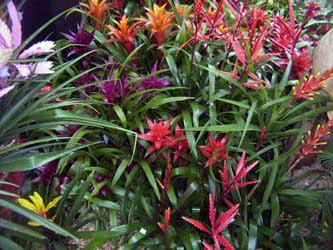
Bromeliads can be grown in containers, on tree trunks or slabs as epiphytes or in well drained, preferably high organic soil. They are generally low growing rosettes, grown for their colour (flower and foliage), hardiness, and unique form and texture.
General Cultural Hints
- If in doubt, provide good light but not direct sun.
- In dry climates, mist foliage in hot weather.
- Generally prefer temperatures above 75 degrees F.
- Don't water (or reduce watering) in cool weather when growth stops.
- After flowering the rosette which produces the flower often dies but is replaced by offshoots - this is natural.
- Brown or dead leaf tips indicate lack of humidity.
- Brown patches on foliage may be sunburn.
- Scale and mealy bug sometimes a problem.
Some Types of Bromeliad
AECHMEA
Generally very hardy, widely grown, size shape and colour extremely variable amongst around 200 species, tolerant of full sun or shade.
ANNAS
8 species, all with spiny leaves. A. comosus (The Pineapple) is the most widely grown, both as a commercial crop and in home gardens. Hardy in well drained but moist soil. Takes up to 2 years to bare fruit.
BILLBERGIA
61 species, foliage generally taller, tubular and with less leaves than other bromeliads, stalks bearing tubular flowers spring from the centre of the plant, very hardy, tolerate full sun.
CRYPTANTHUS (Earth stars)
26 species, form low flattish rosettes, hardy, grow in sun or shade, dry or wet, foliage colours variable, flowers white.
GUSMANIA
158 species, native to wet humid forests, usually growing on trees, flowers yellow to red and orange, avoid cool areas, best in wet tropics.
NEOREGELIA
94 species, great variety in foliage colour and texture, vary from small (3 cm diameter) to large plants (over 1 metre diameter).
NIDULARIUM
42 species, medium size plants, flowers red, white or blue, leaves have fine spines.
TILLANDSIA
Plant size can vary considerably, Difficult at high altitudes, most gave bluish tubular flowers.
VRIESEA
Approx. 290 species, very adaptable though commonly native to tropical rainforests, ideally part shade, spineless leaves, cold tolerant, foliage variable in texture and colours.
Learn more about Gardening and Horticulture
Gardening is a joy, but to get the best results (and save some money in the process) the benefits of learning properly are limitless.
Whether you want to know about particular plant types, about soils and nutrition, what you should look to plant where, plant propagation and much more then we have a course that will suit you. Our courses are all studied by distance learning, and many include practical elements and exercises for you to undertake - this reinforces your learning, and allows you to further develop skills whilst you learn.
Our courses have been extensively developed by horticulturists who have many years of practical experience. Whilst you study, our specialist tutors are on hand to provide guidance and feedback on your work.
Courses are geared towards different levels of existing knowledge and experience - from introductory courses to advanced specialist courses. A selection of our courses and eBooks are shown at the bottom of this page. If you have any questions, or would like help in choosing a course to fit in with your personal aims, or business or career development, then get in touch with our specialist Horticulture tutors today. They will be pleased to hear from you.
[27/04/2024 03:08:41]
More from ACS
Over 150 short courses, certificates and diplomas covering landscaping, crops, plants of all types and general gardening.