Grow Orchids
How to Grow Orchids
While some orchids require quite specific growing conditions to achieve best results, the following general rules can be applied to many commonly grown orchids:
- Most orchids require a very loose open potting mix. These are commonly made from mainly shredded or milled bark, or tree fern fibre.
- In cool climates never water orchids until the bark on the surface of a pot feels dry. Never let the entire pot dry out!
- When watering with a hose, keep the water jet soft and don't wash bark away from any roots.
- Don't water any orchids with icy cold water. Generally make sure water is at least 15 degrees Celsius. This may mean filling a watering can with water from your hose, and if its a bit cold, adding some warmer water from a hot tap. Be careful not to add too much hot water!.
- Over watering is more likely to kill an orchid than under watering. Keep orchids relatively dry when growth is slow or dormant.
- Generally the thicker the stem of the orchid (often called a pseudobulb) the less often it needs to be watered, unless conditions are very hot and dry.
- Avoid potting up orchids into too large a pot. Pot up a pot bound plant into a pot only one or two pot sizes at a time, no more).
- Keep a look out for pests, in particular, aphids, snails, scale or mealy bug insects, and use control methods as soon as they appear.
- Keep orchids in places where conditions are not likely to be changeable.
- In cool climates, don't place them inside near an open window, where cold draughts of air could be a problem.
- Keep them away from gas heaters or stoves.
- Avoid an inside window sill or bench where they will get direct, hot sunlight. Indirect light is preferred by the majority of orchids.
- Avoid direct sun in the hottest part of the day, and generally provide shade in summer.
- Protect flower buds from direct sun, wind, aphids, snails and slugs.
- Do not overfeed. If in doubt, feed regularly with quarter strength fertilisers.
Potting Mixes and Growing Media for Orchids
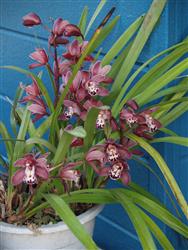 Growing media for orchids is an area of great interest to orchid fanciers and a great deal of experimentation is carried out to try and find the ideal media for different types of orchids. In general growing media for orchids focus on two main groups, these are epiphytic (and lithophytes) and terrestrial (also known as geophytic) orchids. Epiphytic orchids grow on living and fallen trees, and the trunks of tree ferns. Lithophytes naturally grow on rocky outcrops. Terrestrial orchids are those that grow in the ground, although some of these actually grow in leaf litter, rather than in the mineral soil beneath. Some terrestrial orchids will also grow quite readily in soil-less mixes.
Epiphytic orchids can be grown on bark, cork or timber slabs. Placing epiphytic orchids directly onto existing trees has been a favourite techniques for many successful growers. It may be worth noting the natural plant to which the orchid attaches itself in the wild, to increase the chance of success (e.g. is there a preference to Casaurina, Melaleuca, etc). The orchids should be securely tied to the slab, tree, etc., but avoiding damaging the plant, and ensure that the roots are in direct contact with the medium (sometimes called a substrate) they are tied to. The cork, bark or timber pieces can be fixed by such means as simple wire hooks, or durable tying material, to such places as walls, fences, or hanging from trees.
Many epiphytic orchids can also be successfully grown in pots. Both plastic and unglazed terracotta pots are commonly used. The unglazed terracotta pots are especially suited to orchids that require good drainage as they are fairly porous, however, they are also expensive, and can be fairly heavy to lift. Stakes are commonly used, particularly for taller species, to help minimise movement of the plant, which can easily damage the roots.
In general, for epiphytic orchids, mostly inert materials such are used. Many growers commonly use a potting mix that is mostly shredded or milled bark. A good general mix is three parts medium ‑ sized pine bark, one part shredded sphagnum moss and one part perlite.
You can learn all about orchids and how to grow them with our detailed Orchid Culture course. We offer this and a great many other courses focussing on plant varieties and horticulture. Our courses have been developed and are tutored by specialist horticulturalists with extensive knowledge.
If you would like to know more about studying Orchid Culture or any of our other courses which specialise in particular plant varieties, please get in touch with our Horticulture tutors today. They will be pleased to answer your questions and explain more about studying with ACS.
[27/04/2024 13:51:14]
More from ACS
Over 150 short courses, certificates and diplomas covering landscaping, crops, plants of all types and general gardening.