CONTENTS
There are nine lessons as follows:
1. Surveying
Linear surveying
Triangulation
Determining slope
Triangulation
Contouring
Traversing
Levelling terms
Grid systems - datum line, reduced level, back sight, change point, etc.
Types of Level - dumpy, quickset, Cowley
Reading the levelling staff
Levelling procedure
Levelling a sloping site
2. Earthworks
Construction machinery and equipment
Bobcats
Front end loader
Tractor
Backhoe
Bulldozer
Explosives
Shovel, Pick
Cut and fill method
Excavation
Contouring and levelling
Swales
Types of Cultivator - Chisel ploughs, discs and harrows, tined cultivators, rotary hoes, etc.
Calculating earth to move
Prismordial rule
Moving existing earth
Importing soil
Shaping and settling soil
Case Study - Constructing a playing field
Managing Soil degradation -erosion, compaction, salinity, etc
3. Water management
Irrigation systems
Sub-surface
Surface
Sprinkler
Trickle irrigation
Irrigation equipment
Watering cans
Sprinklers
Capillary watering
Automated systems
Water - sources, quality, treatment
Pumps - piston, centrifugal, rotary
Filters
Irrigation scheduling
Pulse watering
4. Environmental control
Atmosphere control
Carbon dioxide effects
Greenhouse considerations
Covering materials
Temperature control
Benching
Shadehouses
Outdoor heating
5. Chemical Applications
Applying pesticides
Parts of a basic sprayer
Calibration
Calibrating a knapsack sprayer
Mixing chemicals
Sprayer maintenance
Safe chemical use
Chemical labelling
Material Safety Data Sheet
Safe chemical storage
Environmental contamination
Protecting outdoor structures from chemical contamination
Paints, Stains and Sealers
Painting outdoor furniture and structures
6. Fencing
Fencing materials - wire mesh, barbed wire, wire strand, posts, strainer assemblies etc
Traditional wire fencing
Semi-suspension fencing
Suspension fencing
Electric fencing
Bpx end assembly
Post and stay assembly
Barriers and walls
Types of timber fence -panels, slats, pickets, hurdles
Fencing houses and pools
Gateways and gates
Rock and rubble walls
Brick walls
Concrete walls
Free standing walls
Retaining walls
Trellises
Wood engineering - softwoods, hardwoods
Preservatives
Hedges
7. Mechanisation
Vehicles
Tractors
The clutch
The transmission
Harvesters
Mowers - rotary, cylinder, flail, ride on
Autonomous Machinery
Hedge trimmers - shears, blade, saw, flail.
Trimmer maintenance
Chain saw use
Chain saw characteristics - petrol, electric, bar size, etc
Chain saw maintenance; extending chain life
Safety with chain saws
Mulching machines
Cultivators
Milking machines
Soil mixing machines
Potting machines
Planters, seeders, drills
Harvesters - potato, carrot
Grading machines
8. Engineering efficiency
Overview
Costs
Quality of product
Replacement parts and servicing
Effectiveness of Autonomous Machinery
Efficiency Limitations and Costs
9. Developing engineering solutions
Introduction
Examples - Rotating Milking Shed
Example - Vineyard Spraying
Handling equipment
Trays boxes, pellets
Trolleys and wheelbarrows
Trailers
Fork lifts
Tractor loaders
Continuous conveying systems - conveyor belts, mono rails, etc
Hoppers
Staff comfort and safety
AIMS
- Explain surveying, including basic principles and techniques, appropriate for horticulture and agriculture.
- Determine earthworks required for an agricultural or horticultural site.
- Determine appropriate water management for an horticultural/agricultural site.
- Determine technological solutions for environmental control problems, in rural or horticultural situations.
- Explain the operation of equipment commonly used to apply pesticides and other chemicals in both horticultural and agricultural workplaces.
- Determine appropriate fencing to use for different purposes; including security and restricting the movement of animals, pests or traffic, in agricultural and horticultural situations.
- Explain the operation of machinery commonly used to mechanise manual tasks carried out in horticultural and agricultural workplaces.
- Evaluate the effectiveness of engineering applications in agricultural and horticultural workplaces.
- Determine procedures for improving work tasks in agricultural and horticultural situations.
Cultivating Soil
Soil is cultivated to make it looser, sometimes so it can be shaped or moved easier; sometimes so you can mix other things into it, and sometimes to prepare it for agricultural or horticultural use.
Don't cultivate soil unless you have a reason though!
Cultivation of soil may be carried out for one or all of these reasons:
- To control weed growth (in this case the cultivation does not need to be very deep. A cut one inch below the surface is sufficient to severely disrupt weed growth. This may be done to kill or remove weeds, before moving earth or changing levels.
- To remove rubbish buried in the soil (e.g. tree stumps, rocks, builders materials, etc) Cultivation can be used to bring such materials to the surface, loosen them in the earth, and/or drag them from the area to be worked.
- To loosen earth so that it can be dug, removed or shaped more easily.
Deep cultivation in some situations can destroy the natural soil profile, creating drainage and other problems. Heavy cultivation (or the weight of heavy machinery), close to or in a water holding area (e.g. watercourse, dam or lake) can crack the impervious layer in the soil which holds the water. In this way, for example it is in fact possible to destroy the natural flow of a creek (by doing construction work over or around it during the dry season).
Chisel Ploughs
Chisel ploughing consists of pulling heavy cultivators tines through the soil at a greater depth than conventional ploughing. This action breaks up or bursts the underlying layers of soil with bringing the subsoil to the surface (as opposed to the soil turning action of other ploughs). These ploughs are useful for improving drainage, aerating the soil, breaking up soil pans and pulling up deep-rooted weeds.
Disc Ploughs
This consists of a series of discs mounted individually at an angle to the ground. Drawn behind a tractor they rotate as they cut the soil. The tilted angle helps to turn the soil over but decreases the depth of the cut.
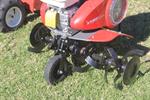 Rotary Cultivators
Rotary hoes can be either self propelled units (common in earthworks for a home garden) or tractor mounted units. This type of machine mixes the soil more thoroughly than most other types of cultivators. Rotary hoes will bring buried materials to the surface, allowing the ground to be cleaned up. As such, it can be more destructive to the soil profile. In situations where the soil profile is not of significant concern, the rotary hoe is perhaps the most efficient machine.
Disc Cultivators or Harrows
Similar to disc plough but with discs closer together and mounted in pairs. They are comprised of a number of sets (gangs) of concave discs which can be set at variable angle to the direction of travel. The greater the set of the disc angle, the more severe the resulting disruption of the soil. The discs turn and breakdown the soil surface.
Spring Tined Cultivators and Scarifiers
These tractor mounted cultivators are more like single fixed spikes which are dragged through the soil. While ripping and loosening the soil this type of implement does less mixing of soil than the disc or rotary implements. As the tines are drawn through the soil the flexibility and movement of the tines allows them to vibrate and this helps break down soil clods.
THIS COURSE CAN HELP YOU TO:
- Better understand how to use engineering solutions in a range of jobs.
- Gain confidence in this field.
- Use this course for professional development in your current position.
- Make you more knowledgeable and employable.